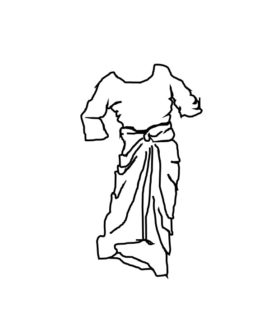
The word aso in Yoruba means cloth and ebi denotes family, so Aso ebi can be described as a family cloth usually worn during funerals or family ceremonies. However, the practice is now beyond family dressing because strangers of a celebrant can wear the Aso ebi.
Ayodele Olukoju, a Nigerian economic historian believes Aso ebi became a novelty in 1920 during a period of post World War I economic boom [1] triggered by the higher prices for produce products such as Oil palm. However, William Bascom traced the origin to an earlier period when members of Yoruba age grades wear uniform dressing to mark fraternal bonds.[2] In the 1950s, members of women organizations or egbes turn out to ceremonies and anniversaries of relatives in the same style of dress, sandals, lappa, smock, necklace, the culture signifies close friendship. The uniform dressing can also be a measure of personal affluence because Aso ebi involves rivalry between various egbes or groups with each group competing to out shine each other in terms of quality, originality and richness of the uniform[3]
Showing the single result